
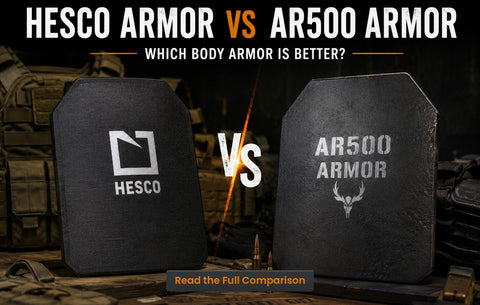
Before choosing body armor, you need to understand one thing: not all armor is built for the same mission. Some plates prioritize weight and comfort. Others focus on affordability. And some are built like tanks but feel like you’re carrying one.
If you’ve been comparing HESCO Armor and AR500 Armor, you’ve probably noticed a split in the tactical community. One side swears by lightweight ceramic. The other praises steel for durability and price. So who’s right?
The answer depends on your threat profile, your budget, and how long you plan to wear it.
Below is the complete outline, first structured in a clear hierarchy.
Understanding the Core Difference
At the center of this debate is material science, especially when comparing ceramic vs steel armor and how each reacts under ballistic impact.
HESCO primarily dominates the market with ceramic and composite armor plates, while AR500 became known for steel body armor. That’s like comparing a carbon-fiber racing bike to a steel mountain bike. Both can take you places, but they perform differently under stress.
Ceramic armor works by breaking apart the incoming round, dispersing energy across the plate. Steel armor does the opposite. It stays rigid and stops rounds through sheer hardness.
That sounds simple enough, but here’s where things get complicated.
Steel is often praised for durability, but it comes with serious drawbacks: weight, spall, and reduced comfort. Ceramic is lighter and safer in many scenarios, but it can be more expensive and less forgiving when mishandled.
This isn’t just opinion. Modern armor specialists increasingly recommend ceramic over steel for most defensive applications because of those tradeoffs. Tactical communities on Reddit and professional armor retailers regularly point out that lightweight ceramic HESCO plates outperform steel for real-world wearability.
What Is HESCO Armor?
HESCO has built one of the strongest reputations in the body armor industry. The military, law enforcement, and civilian tactical users widely use their products.
Founded in the UK and now operating heavily in the U.S., HESCO focuses on advanced ballistic solutions using ceramic, UHMWPE (Ultra-High-Molecular-Weight Polyethylene), and hybrid composites.
What makes HESCO stand out?
They focus heavily on weight reduction without sacrificing protection.
That’s a big deal. If you’ve ever worn plates for eight hours, you know every pound feels heavier by the minute.
Popular HESCO Plate Models
L210 and L211
These are HESCO’s most talked-about special threat plates.
Why?
Because they’re light, slim, and capable of stopping popular threats like 5.56 M193 and M855, they’re not full Level IV, but for many civilian users, they hit the sweet spot.
Weight usually sits around 5.4 lbs per plate, which feels dramatically lighter than steel alternatives.
4400 Series
The 4400 series is HESCO’s heavyweight Level IV option.
This line is designed for armor-piercing threats and carries strong credibility among tactical professionals.
Think of it like upgrading from a shield to a fortress wall.
What Is AR500 Armor?
AR500 Armor became popular by making armor more affordable.
Their name comes from the steel itself: AR500 steel, an abrasion-resistant steel with a hardness rating around 500 Brinell.
The idea was simple:
Make armor tough, cheap, and multi-hit capable.
And it worked.
For years, AR500 steel plates became the entry point for first-time buyers.
Popular AR500 Plate Options
Level III Steel Plates
These are their flagship.
They can stop .308 rounds under NIJ Level III conditions, but there’s a catch.
Not all steel performs equally against high-velocity threats like M193 at close range.
This is where ceramic often pulls ahead.
Hybrid Systems
AR500 also now offers ceramic options, which says a lot.
Even AR500 recognized that the market shifted away from pure steel.
That’s not an accident.
Ballistic Protection Comparison
This is where things get serious.
Protection is the whole point, and understanding armor ratings helps make sense of what each plate is truly designed to stop.
| Feature | HESCO Ceramic | AR500 Steel |
|---|---|---|
| Rifle Protection | Excellent | Good |
| Armor Piercing Resistance | Strong (Level IV models) | Limited |
| M855 Green Tip | Strong | Variable |
| Spall Risk | Low | High |
| Weight | Light to Medium | Heavy |
| Multi-hit Potential | High | Very High |
According to the National Institute of Justice (NIJ), certified armor remains the benchmark for real-world ballistic trustworthiness. NIJ still maintains active compliance lists for armor products under 0101.06 through at least 2027 while transitioning to 0101.07 standards.
That matters.
Always check whether your plate is actually listed.
Marketing claims mean nothing without certification.
Threat Performance
Steel can struggle against certain fast-moving rounds.
That surprises many buyers.
People assume “harder” equals “better.”
Not always.
A lightweight ceramic plate may outperform steel against specific threats because ceramics disrupt the bullet differently.
It’s like punching sand versus punching a brick wall. Sand absorbs energy. Brick redirects it.
That energy redirection can become dangerous.
Weight and Comfort Comparison
Let’s talk about reality.
Because wearing armor on a product page and wearing it during movement are two different worlds.
Steel plates commonly weigh 7 to 9 pounds each.
Ceramic plates like HESCO’s often range from 4.5 to 7 pounds, depending on rating.
That difference adds up.
Front and back?
That’s 4 to 8 pounds saved.
Now add ammo, med kits, radios, and water.
Suddenly, those “few pounds” feel like an anchor.
Professional armor comparisons consistently emphasize that lighter setups improve mobility, reduce fatigue, and increase survivability under stress.
And comfort? Plate shape matters just as much, which is why understanding plate cuts can make a major difference in fit and mobility.
Multi-curve ceramic wins almost every time.
No debate.
Wearability for Extended Use
Think of armor like shoes.
You can wear work boots to run a marathon, but you’ll regret it.
Steel armor feels the same.
Short-term? Fine.
Long-term? Miserable.
That’s why law enforcement and military professionals rarely choose steel anymore.
Mobility matters.
Durability and Longevity
This is AR500’s strongest argument.
Steel is incredibly durable.
Drop it?
Usually fine.
Bang it around?
Still fine.
Ceramics can crack if abused.
That concern is valid.
But modern ceramics are tougher than people think.
Manufacturers have improved significantly.
And most ceramic cracks don’t automatically equal failure.
Drop Resistance
Steel wins.
Simple.
If you expect rough handling or storage abuse, steel handles it better.
But remember: armor isn’t supposed to be abused.
It’s supposed to protect you.
That’s like buying a race car because it survives parking lot fender benders.
Wrong priority.
Multi-hit Capability
Steel has legendary multi-hit performance.
It can take repeated hits without structural collapse.
Ceramic sacrifices part of itself each time it stops a round.
That’s the tradeoff.
But unless you’re expecting multiple direct impacts in the same area, ceramic still performs exceptionally well.
Spall and Fragmentation Risks
This is the biggest strike against AR500.
And it’s a serious one.
When steel stops a round, fragments can spray outward.
That’s called spall.
Those fragments can hit your neck, arms, legs, or teammates.
Even anti-spall coatings help only so much.
This is one reason many experts moved away from steel entirely.
Industry armor guides continue to warn that steel plates create fragmentation risks that ceramic largely avoids.
This isn’t a minor issue.
It can be life-changing.
Cost Comparison
AR500 wins on price.
No surprise.
| Armor Type | Average Price Per Plate |
|---|---|
| AR500 Steel Level III | $100–$180 |
| HESCO L210 | $180–$250 |
| HESCO Level IV | $220–$450 |
If your budget is tight, AR500 looks attractive.
But here’s the question:
Are you saving money or buying compromises?
That depends on what your life is worth to you.
Harsh?
Maybe.
But accurate.
Which One Is Better for Different Users?
For Home Defense
HESCO wins.
Lighter, faster, safer.
You’re moving indoors, not holding static positions.
Mobility matters.
For Training
AR500 can make sense.
Cheaper.
Tougher.
Less worry about damage.
Good for range days.
For Tactical Professionals
HESCO.
Almost universally.
Weight savings and reduced spall risk are too important.
For Budget Buyers
AR500 still has a place.
But know what you’re trading.
It’s like buying economy tires for a sports car.
They work.
Until they don’t.
Final Verdict
If your goal is best overall protection, HESCO wins.
Not because steel is useless.
But because ceramic has become the modern standard for a reason.
It’s lighter.
Safer.
More versatile.
More comfortable.
AR500 still works for niche applications, training, and extreme budget setups.
But if you’re asking which is better, not cheaper?
HESCO takes it.
That’s where most experienced armor users land.
And the market trend reflects it.
Even brands built on steel are increasingly expanding into ceramics.
That tells you everything.
Conclusion
Choosing between HESCO and AR500 isn’t really about brand loyalty. It’s about understanding your mission.
If you need armor for serious defensive use, HESCO gives you a better balance of protection, mobility, and survivability.
If you need affordable plates for training or backup gear, AR500 still holds value.
Body armor is one of those purchases where cutting corners can cost more than money.
Buy for your threat, not your ego.
Because when things go bad, your armor isn’t just gear.
It’s the last wall between you and disaster.
Shop Genuine HESCO Armor Plates at Shield Concept
If you're in the market for body armor plates, Shield Concept is an authorized HESCO Armor retailer offering genuine body armor for sale in our inventory. Get trusted ballistic protection, competitive pricing, fast shipping, and genuine quality for your money, backed by up to a 5-year manufacturer's express limited warranty.
Shop HESCO Armor PlatesFAQs
1. Is HESCO armor better than AR500?
For most users, yes. HESCO ceramic plates offer greater weight savings, lower spall risk, and stronger performance against modern threats.
2. Does AR500 steel armor stop M855?
Some do, but performance varies by plate and velocity. Always verify testing data.
3. Is ceramic armor fragile?
Not as fragile as many think. Modern ceramic plates are durable enough for real-world tactical use when properly handled.
4. Why do many professionals avoid steel armor?
Mainly because of spall, weight, and reduced mobility.
5. Is HESCO NIJ certified?
Many HESCO models are listed under NIJ standards. Always confirm specific models before buying.