
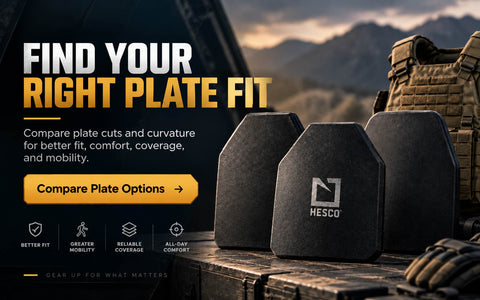
Choosing the right body armor plate involves more than selecting a protection level. Plate shape and curvature also affect mobility, comfort, fit, and coverage. So your plate must match your body, carrier, and planned use.
How Body Armor Plate Shapes Differ
Armor plates are available in a number of common shapes, though Shooter Cut, SAPI Cut, and Full Cut are still among the most widely chosen types. Each of these designs alters the quantity of material situated around the shoulders and upper chest.
It therefore affects movement while still providing protection over the desired part of the torso, and correct sizing is essential in each case.
Shooter Cut Plates: More Shoulder Mobility
Because shooter cut plates have more aggressive shoulder angles than many conventional plate shapes, they leave extra space around the shoulders.
Consequently, this type of cut may seem less restrictive when carrying out upper-body movements and will also give more clearance when shouldering equipment.
Shooter Cut plates are also usually available in sizes of 10 by 12 inches. Yet the exact dimensions will differ according to the manufacturer and the particular model of plate.
For most users, the Shooter Cut provides a practical compromise between mobility and coverage. That said, it is important to have the right fit before considering cut preference.
SAPI Cut Plates: Balanced Coverage and Mobility
The geometry of SAPI Cut plates is the same as that used in military armor systems and their shoulder angles are usually less steep than those of Shooter Cut designs.
Consequently, SAPI plates tend to keep more material close to the upper edges, and at the same time they also offer shoulder relief.
A further benefit relates to sizing, since SAPI plates are usually available in standard sizes going from extra small to extra large.
For instance, a typical SAPI plate has dimensions of about 9.5 by 12.5 inches. Sizes other than that are based on this format.
SAPI Cut is well suited to people who favor structured sizing and is also appropriate for carriers that are designed according to SAPI dimensions.
Full Cut Plates: Broader Plate Area
Full Cut plates leave the upper corners rather than cutting away the material around the shoulders. This causes them to have a wider plate profile.
But the extra material could cause a lesser degree of shoulder mobility for certain users. The shape of the body, the size of the plate, and the design of the carrier are all important.
Full Cut plates are especially suitable for use as backplates since many users require less shoulder clearance on the rear part of the torso.
Moreover, manufacturers provide Full Cut plates in a number of sizes, with some ranges having compact dimensions for use in special armor applications.
Single Curve Plates: Simple Contouring
The curvature refers to the way the plate bends around the torso, and the Single Curve plate bends mainly in one direction.
Consequently, it forms a simple curved surface which fits many users comfortably.
Yet the shapes of the body are very different. In some cases, a basic curve may result in pressure points during prolonged use.
Single Curve plates might also be cheaper than the corresponding Multi Curve ones. That said, fit and protection should still be given top priority.
Multi Curve Plates: A More Contoured Fit
Since the multi curve plates have a number of contours over the surface of the plate, they are able to follow the shape of the torso more naturally.
Consequently, a great many users find the devices more comfortable when they are worn for longer periods, and the contour can also assist in getting the plate to sit nearer.
A closer fit might also lessen the unwanted movement within a carrier which has been properly adjusted. That said, the way in which the carrier is set up is still very important.
Most present-day hard armor models use Multi Curve profiles together with Shooter Cut or SAPI Cut shapes.
Flat Plates: Best for Specific Uses
Flat plates are also used in certain armor systems, but flat designs usually fit the front of the torso less closely.
Consequently, people might find them less comfortable after wearing them for a long time. Yet some smaller plates or special inserts could make effective use of flat profiles.
In the end, it is up to the choice of placement and the design of the equipment to decide whether a flat plate is suitable.
How Plate Shape Affects Movement
The shape of the plate is most apparent around the shoulders and more severe cuts tend to remove a greater amount of material from the upper corners.
Hence Shooter Cut plates generally give more shoulder clearance, while SAPI Cut plates offer something in between in terms of mobility and the area of the plate.
In the meantime the Full Cut plates keep more material close to the shoulders. This design could provide more extensive coverage at the same time as reducing movement for certain users.
It does not follow that a greater plate area will result in a better arrangement. A plate that is too large may妨碍 movement and the placement of the carrier.
How Plate Curvature Impacts Comfort
The way the plate contacts your body is affected by its curvature, so when it comes to making a choice between the Single Curve and the Multi Curve, comfort is usually the determining factor.
A Multi Curve plate is able to distribute contact in a more natural way over the torso and this may cause it to feel less rigid when worn for a longer period of time.
Yet all people are different; variations in chest depth, shoulder width, torso length, and carrier design can affect how any plate feels.
That is why it is just as important for the size of the plate to be right as for its curvature. A high-quality kind of armor can still cause discomfort if the size is incorrect.
Choosing the Right Plate Shape and Curvature
Begin by using the right plate size and ensuring carrier compatibility. Then, compare the available cuts in relation to your movement and coverage requirements.
Go for the Shooter Cut when shoulder mobility is most important and opt for the SAPI Cut if you would like structured sizing together with balanced coverage.
Full Cut might be a good choice for people who value a larger plate area, and it could also be suitable for use with backplates.
Next, compare the Single Curve and Multi Curve options; Single Curve provides simpler contouring whereas Multi Curve matches the torso more closely.
Hesco offers Shooter, SAPI, Full, and Swimmer cuts for various armor lines, plus flat, Single Curve, and Multi Curve options.
Final Fit Matters Most
The right plate shape should support protection needs without creating unnecessary restriction. Likewise, curvature should help the plate sit securely.
So don't choose body armor by cut name alone. Confirm dimensions, curvature, carrier compatibility, and tested protection before purchasing.
Ultimately, the right plate should fit securely, allow practical movement, and match your intended setup.
Shop Genuine HESCO Armor
Find the Right Body Armor for Your Setup
If you're in the market for body armor, Shield Concept offers genuine HESCO armor plates with competitive pricing, fast shipping, and dependable quality. Browse our inventory to find the plate shape, curvature, size, and protection level that fits your needs.
Shop Body Armor