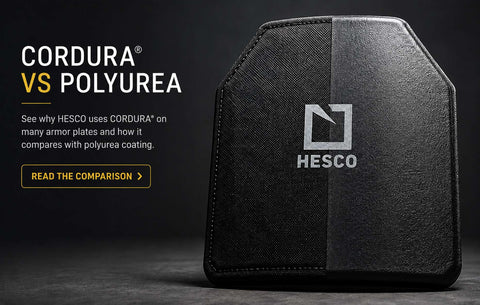
When comparing HESCO armor plates, one easily overlooked detail is the material covering the outside of the plate. Many HESCO models use a CORDURA® fabric finish, while certain configurations are available with a sprayed-on polyurea coating. At first glance, a hard spray coating may appear to offer an obvious durability advantage. In practice, however, plate covering is an engineering decision that involves far more than simply choosing the toughest-looking exterior.
We have to consider weight, thickness, abrasion resistance, moisture protection, chemical resistance, manufacturing consistency, handling characteristics, and the intended operating environment. The outer covering also should not be confused with the ballistic core itself. Its primary role is to protect and encapsulate the plate system, not define the plate’s ballistic rating.
HESCO currently describes armor within its product range as using a highly durable, water-resistant polyurethane-coated CORDURA® fabric finish, while some products are also offered with sprayed-on polyurea finishes. Understanding why both options exist makes it much easier to determine what each exterior treatment contributes to the finished armor plate.
What Is the CORDURA® Cover Used on HESCO Armor Plates?
CORDURA® is not simply ordinary nylon fabric. The CORDURA® family includes engineered textiles developed for applications where abrasion resistance, tear strength, and long-term durability are important.
CORDURA® Ballistic Fabric, for example, is manufactured using high-tenacity nylon 6,6 filament yarns designed to provide enhanced resistance to tearing and abrasion. CORDURA® describes the material as having roots in woven nylon originally developed for military body armor applications.
Other CORDURA® constructions similarly emphasize resistance to abrasion, tears, scuffs, and environmental exposure. CORDURA® Classic Fabric is produced with high-tenacity fibers and is available in multiple fabric weights, while also offering water repellency.
For an armor plate, those characteristics are valuable because the plate exterior experiences repeated contact with the inside of a plate carrier, hook-and-loop materials, straps, equipment, storage surfaces, and other gear.
Rather than enclosing the plate inside a comparatively substantial sprayed shell, a fabric covering can create a thin, flexible protective exterior around the armor package.
That distinction is important.
The objective is not necessarily to create the hardest possible outer surface. Instead, the goal is to provide enough environmental and mechanical protection while keeping unnecessary material, bulk, and weight under control.
Why CORDURA® Is Well Suited to Ballistic Plate Construction
One of the most important advantages of a CORDURA® covering is its strength-to-weight efficiency.
Body armor is unusually sensitive to incremental weight increases. A difference that seems insignificant with a single plate becomes more meaningful when you combine front and rear plates, side armor, a plate carrier, communications equipment, medical equipment, ammunition, hydration, and other mission gear.
For this reason, armor manufacturers continuously balance protection against overall system weight.
A fabric encapsulation system can provide substantial resistance to routine wear without requiring a thick exterior coating. CORDURA® materials are engineered for applications that require toughness without excessive mass, and the company supplies fabric technologies used throughout military equipment, including ballistic vests, packs, uniforms, boots, and related tactical applications.
The fabric also conforms naturally to the plate’s geometry.
Modern armor plates are rarely simple flat rectangles. They may incorporate single curves, multi-curves, shooter cuts, SAPI-style profiles, tapered corners, and carefully shaped edges designed to improve mobility and carrier fit.
A textile exterior can follow these contours without substantially changing the plate's dimensions.
CORDURA® Helps Protect the Plate Without Adding Unnecessary Bulk
Armor plate thickness matters for more than specification sheets.
A thicker plate occupies more space inside the plate carrier and can change how the carrier sits against the body. Added material around the edges can also influence how easily a plate slides into or out of a properly sized plate bag.
Because a fabric wrap is comparatively thin, it allows the manufacturer to protect the armor package while preserving the dimensions created by the underlying ballistic design.
This is especially relevant with lightweight composite armor, where engineers may invest significant effort into reducing fractions of an inch and ounces from the finished product.
Adding an unnecessarily heavy exterior treatment would work against that objective.
A CORDURA® covering therefore represents a practical engineering approach: protect the armor package while interfering as little as possible with its weight, profile, and geometry.
Is a CORDURA®-Wrapped Armor Plate Water Resistant?
Yes, although it is important to distinguish water resistance from complete waterproof encapsulation.
HESCO specifically describes its standard finish as water-resistant polyurethane-coated CORDURA® fabric. CORDURA® also produces multiple nylon fabric technologies designed with water-repellent or coated constructions.
That means the presence of fabric should not automatically be interpreted as meaning an armor plate has an unprotected textile shell that freely absorbs environmental moisture.
The fabric and its coating work together as a protective exterior.
For typical operational use, this construction provides abrasion resistance, tear resistance, flexibility, and moisture resistance without requiring complete encapsulation in a thick elastomeric coating.
Polyurea can nevertheless provide a more continuous barrier because it is sprayed directly onto the prepared surface and cures into a seamless exterior layer. That difference is one reason polyurea can be attractive where unusually severe environmental exposure is expected.
What Is a Polyurea-Coated Armor Plate?
A polyurea coating is a sprayed elastomeric protective material that cures rapidly into a continuous surface.
The technology extends far beyond truck bed liners. Specialized polyurea formulations are used in industrial, military, infrastructure, vehicle, and defense applications where resistance to impact, abrasion, chemicals, weather, and environmental damage is important.
Rhino Linings, whose technologies include coatings designed specifically for security and defense applications, describes its RhinoArmor™ products as polyurea systems engineered for demanding military environments. Its coatings are designed to create a seamless protective barrier and can resist abrasion, impact, weather, chemicals, and other forms of exposure, depending on the specific formulation.
That makes polyurea an effective armor encapsulation option when its specific properties are desirable.
It does not, however, mean that every armor plate automatically benefits from replacing a fabric covering with a sprayed coating.
CORDURA® vs. Polyurea Armor Plate Coatings
The two materials solve similar problems in fundamentally different ways.
CORDURA® protects a high-strength woven textile system. Polyurea protects a seamless elastomeric membrane.
Neither construction should be evaluated simply by asking which one is “stronger.” The more relevant question is which covering provides the appropriate combination of protection, weight, thickness, environmental resistance, and durability for a particular armor design.
CORDURA® Plate Cover Advantages
A properly designed CORDURA® armor plate covering can provide:
- Excellent abrasion resistance
- High tear resistance
- Water-resistant construction
- Low additional weight
- Minimal added thickness
- Flexible conformity around curved armor
- Protection against routine handling and carrier wear
- A proven textile platform with extensive military use
CORDURA® Ballistic Fabric specifically uses high-tenacity nylon 6,6 yarns for increased resistance to abrasion and tearing, characteristics directly relevant to protective equipment exposed to repeated mechanical wear.
Polyurea Plate Coating Advantages
Depending upon the formulation and armor construction, a sprayed polyurea finish can provide:
- Seamless surface encapsulation
- Strong environmental resistance
- Excellent abrasion resistance
- Impact resistance
- Chemical resistance
- Resistance to moisture penetration
- Durable protection around complex surfaces
Rhino Linings’ defense-oriented polyurea systems illustrate why these coatings are attractive for extreme environments. The company highlights impact, abrasion, chemical, corrosion, and environmental protection as capabilities of its military and defense coating technologies.
The tradeoff is that a sprayed coating becomes another engineered component of the armor system. Its thickness, mass, adhesion, formulation, and application process must all be controlled.
Why Not Put a Heavy Polyurea Coating on Every Armor Plate?
Because more exterior material does not automatically make an armor plate better.
Every design choice has consequences.
When engineers design lightweight armor, they are managing a strict weight and dimensional budget. If an existing fabric encapsulation already provides the required durability and environmental protection, adding additional coating thickness or mass may produce little practical benefit for the intended application.
This is especially significant in premium lightweight armor.
Reducing armor weight can improve mobility and make equipment easier to wear over extended periods. Adding material solely because it appears more rugged can undermine that design objective.
The correct exterior finish is therefore the one that satisfies the plate’s engineering requirements while imposing the smallest unnecessary penalty.
For many HESCO designs, polyurethane-coated CORDURA® provides that balance.
For applications that call for different environmental characteristics, sprayed polyurea remains a viable alternative.
Does Polyurea Make an Armor Plate More Ballistically Protective?
The presence of polyurea should not be treated as a shortcut for determining a plate’s ballistic capability.
A hard armor plate is a carefully engineered system. Depending upon its construction, it can incorporate combinations of ceramic strike-face materials, composite backing materials, adhesives, protective layers, edge treatments, and exterior encapsulation.
The exterior covering is one component of that system.
Ballistic capability should therefore be determined from the specific plate model, threat rating, manufacturer specifications, and applicable test documentation, rather than from whether the exterior appears to be fabric or spray-coated.
A polyurea-covered plate should not automatically be assumed to provide greater ballistic protection than a CORDURA®-wrapped model. Likewise, a fabric-covered plate should not be assumed to be less durable simply because its exterior is textile-based.
The ballistic system has to be evaluated as a whole.
Why Abrasion Resistance Matters for Armor Plate Covers
Armor plates can experience substantial non-ballistic wear throughout their service life.
Every time a plate is inserted into a carrier, removed for inspection, transported in equipment cases, placed on hard surfaces, or worn during movement, its outer surface can experience friction.
The edges are particularly vulnerable because they can repeatedly contact a carrier's interior seams.
CORDURA® is particularly well suited to this type of environment because abrasion resistance is one of the fundamental characteristics for which the material was developed. CORDURA® states that its high-tenacity nylon technologies are engineered to resist abrasion, tears, and scuffs, and rugged fabrics are used extensively across military equipment.
This provides an important distinction between cosmetic appearance and functional durability.
A fabric-covered plate may develop superficial wear over time without that observation alone establishing that its internal ballistic structure has been compromised.
Any suspected plate damage, however, should be evaluated according to the armor manufacturer’s inspection and replacement instructions.
Why Tear Resistance Matters Around Plate Edges
Armor plate edges experience a different form of stress than broad plate surfaces.
The curved and tapered edges may repeatedly rub against a carrier or adjacent equipment. When the user bends, kneels, runs, climbs, or changes position, the carrier itself flexes around a rigid plate.
A suitable covering therefore needs enough flexibility to conform to these transitions while resisting tearing.
This is one area where a high-tenacity woven fabric performs particularly well.
CORDURA® Ballistic Fabric combines dense woven construction with high-tenacity nylon filament yarns specifically intended to increase tear and abrasion resistance. Rather than behaving as a brittle outer shell, the textile can flex with the external geometry of the armor package.
Polyurethane-Coated CORDURA® and Polyurea Are Not the Same Thing
The terminology can be confusing.
A polyurethane-coated CORDURA® plate uses CORDURA® fabric that has a protective polyurethane treatment or coating.
A polyurea-coated plate, by comparison, uses a spray-applied elastomeric coating around the armor package.
Those are different construction methods.
This distinction matters because descriptions such as “coated CORDURA®” may lead shoppers to assume that the plate uses the same type of thick sprayed coating associated with industrial bed liners.
HESCO’s product literature specifically identifies polyurethane-coated CORDURA® fabric while separately identifying sprayed-on polyurea as another available exterior option on applicable models.
Understanding that distinction makes HESCO armor specifications considerably easier to compare.
When Does a Polyurea Finish Make Sense?
Polyurea becomes particularly interesting when the armor’s intended environment demands continuous surface encapsulation and resistance to aggressive environmental exposure.
Specialized polyurea formulations can create seamless coatings with excellent abrasion and impact resistance. Some formulations also offer significant chemical and corrosion resistance. Rhino Linings, for example, produces defense coatings intended for military equipment and body armor encapsulation applications.
For specialized operational environments, those properties can justify a different coating system.
The important point is that polyurea should be considered an engineering option rather than a universal upgrade.
A feature that is advantageous under one set of operating requirements can add unnecessary material under another.
Why HESCO Offers More Than One Armor Plate Finish
The availability of different exterior finishes reflects an important principle of armor engineering: no single material combination is optimal for every requirement.
Armor designed primarily around low weight and mobility has different priorities from armor intended for unusually harsh chemical or environmental exposure.
HESCO’s current armor range demonstrates this approach. Its product information identifies durable, water-resistant polyurethane-coated CORDURA® fabric across its armor offerings, with certain configurations also available using sprayed-on polyurea.
That gives armor designers and end users the ability to select the construction appropriate to the application instead of automatically carrying the weight, thickness, or manufacturing implications of a coating that may not be necessary.
CORDURA® vs. Polyurea: Which Armor Plate Finish Is Better?
Neither finish should be declared universally superior.
For many general-purpose armor applications, CORDURA® offers an exceptionally efficient combination of toughness, water resistance, flexibility, low weight, and low bulk. Its extensive history in military equipment and its resistance to tears, abrasion, and scuffs make it particularly well suited to protecting an armor package from routine handling and operational wear.
Polyurea offers a different advantage.
A properly formulated spray coating creates a continuous elastomeric barrier that can provide excellent resistance to environmental exposure, impact, abrasion, and chemicals. Those properties make polyurea valuable when the armor system or intended operating conditions justify them.
The real comparison is therefore not:
Fabric versus a tougher coating.
It is:
A lightweight engineered textile encapsulation versus a seamless engineered elastomeric encapsulation.
Once the distinction is understood, HESCO’s use of CORDURA® makes considerably more sense.
Does the Plate Cover Determine Armor Quality?
No single exterior feature determines the quality of a ballistic plate.
We should evaluate armor by looking at the complete system: manufacturer, plate construction, verified threat performance, weight, thickness, shape, size, durability requirements, testing, and intended application.
Exterior finish belongs in that evaluation, but it should not replace it.
A premium lightweight plate wrapped in CORDURA® is not inherently inferior to a polyurea-coated plate. In fact, the fabric covering may have been selected precisely because it provides the required environmental protection while allowing engineers to keep the finished plate lighter and thinner.
Likewise, a polyurea finish should not be dismissed as unnecessary. Where continuous encapsulation or enhanced resistance to certain environmental exposures is required, it can be an excellent solution.
The covering needs to complement the underlying armor architecture rather than compete with it.
The Bottom Line on HESCO CORDURA® vs. Polyurea Armor Plates
HESCO’s use of polyurethane-coated CORDURA® fabric is best understood as a deliberate balance between durability and efficiency.
CORDURA® provides the characteristics an armor plate exterior frequently needs: high tear strength, abrasion resistance, flexibility, water resistance, low bulk, and low additional weight. Its military heritage and widespread use in demanding tactical equipment further make it a logical material for armor encapsulation.
Sprayed polyurea coatings offer another highly capable solution. Their seamless construction can provide substantial impact, abrasion, moisture, chemical, and environmental resistance, making them valuable for specialized armor configurations and demanding operating environments.
The key is recognizing that a polyurea coating is not automatically an upgrade over CORDURA®, nor does using fabric represent a compromise in armor quality.
For an armor manufacturer, every ounce and every fraction of an inch matter. When a lightweight, abrasion-resistant, tear-resistant, water-resistant CORDURA® system already provides the required protection around the ballistic package, adding a heavier or thicker encapsulation system simply for a sprayed exterior may offer no meaningful advantage.
That is why CORDURA® remains such a practical armor plate covering, while polyurea continues to serve as a valuable alternative when its particular environmental and encapsulation properties are required.
Shop Genuine HESCO Armor
If you're in the market for genuine HESCO Armor, shop with confidence at Shield Concept. As an authorized HESCO Armor retailer, we offer authentic armor plates at competitive prices, fast shipping, and manufacturer-backed quality, with eligible products covered by up to a 5-year manufacturer's warranty.
Shop HESCO Armor →