Introducing the Defender-ST
Red dot optics have evolved dramatically over the past decade. What started as an accessory mainly reserved for competition shooters has become a mainstream upgrade for concealed carry pistols, duty handguns, tactical shotguns, and even AR-platform rifles. Modern shooters expect one optic to survive thousands of rounds, maintain zero after repeated impacts, provide instant target acquisition, and remain visible under bright sunlight. Meeting all those expectations is no easy task, yet that is exactly what Vortex Optics set out to accomplish with the Defender-ST Micro Red Dot.
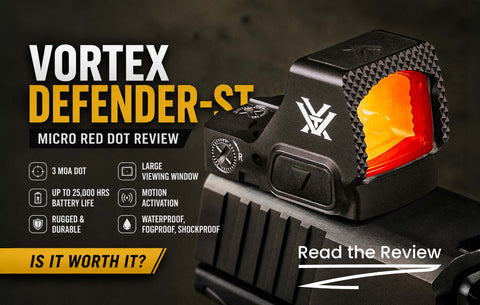
Rather than designing another lightweight range optic, Vortex built the Defender-ST with durability and versatility in mind. The optic shares the DeltaPoint Pro mounting footprint, making it compatible with a wide variety of factory optics-ready pistols and aftermarket mounting solutions. Its intended role extends well beyond everyday carry. Whether mounted on a defensive handgun, a patrol shotgun, or as a 45-degree offset optic on a carbine, the Defender-ST is engineered to provide rapid target acquisition while withstanding demanding conditions. According to Vortex, the optic incorporates features such as a large viewing window, ShockShield polymer insert, Fast-Rack textured front face, motion activation, and a top-loading CR2032 battery capable of up to 25,000 hours of runtime under typical operating conditions.
The question most shooters ask is simple: does it justify its price? Premium pistol optics have become increasingly competitive, with respected options from Trijicon, Aimpoint, Holosun, and Leupold all competing for the same buyers. If you're comparing Vortex models specifically, our Defender-XL review offers a closer look at the larger competition-focused optic and how it differs from the Defender-ST. Choosing one often comes down to balancing durability, battery life, optical clarity, and ease of use. The Defender-ST enters this crowded field with impressive on-paper specifications, but specifications alone rarely tell the whole story. Throughout this review, we’ll examine how its features translate into practical performance and whether it truly deserves a place on your firearm.
Who Is the Defender-ST Designed For?

One of the biggest strengths of the Defender-ST is that it avoids limiting itself to a single role. Many micro red dots excel either as concealed-carry optics or competition optics, but relatively few are equally comfortable transitioning between firearm platforms. The Defender-ST was specifically engineered as a true multi-platform optic, giving shooters flexibility without requiring multiple sight purchases.
For handgun owners, the optic’s generous viewing window makes drawing and locating the dot noticeably easier, particularly for newer shooters still developing their presentation technique. Experienced shooters will appreciate how the larger field of view helps maintain peripheral awareness while tracking moving targets. The 3 MOA dot strikes a practical balance between precision and speed, remaining small enough for accurate shots at distance while still being easy to acquire during close-range defensive drills.
Shotgun users also benefit from the Defender-ST’s rugged construction. Defensive shotguns generate significant recoil, and not every miniature optic is designed to endure that level of punishment over thousands of rounds. Features like the ShockShield polymer insert, waterproof housing, fogproof construction, and shockproof engineering are intended specifically for repeated heavy use in adverse environments.
Carbine shooters gain another advantage thanks to the DeltaPoint Pro footprint. Mounted at a 45-degree offset, the Defender-ST becomes an excellent secondary aiming solution for transitioning between magnified optics and close-range engagements. Instead of adjusting magnification, shooters cant the rifle slightly and engage targets instantly. That versatility explains why Vortex markets the Defender-ST toward recreational shooters, self-defense users, and professional military and law enforcement personnel alike.
The optic is equally attractive for shooters who value simplified maintenance. Unlike many competing designs requiring optic removal during battery replacement, the Defender-ST features a top-mounted battery compartment, allowing fresh batteries to be installed without disturbing zero. That small design choice eliminates unnecessary trips back to the range after routine maintenance and reflects thoughtful engineering aimed at real-world users rather than marketing checklists.
Key Specifications at a Glance
Before evaluating performance, it’s worth looking at the numbers behind the Defender-ST. Specifications never tell the entire story, but they do provide valuable insight into what the optic was engineered to accomplish.
| Specification | Vortex Defender-ST |
|---|---|
| Mounting Footprint | DeltaPoint Pro |
| Dot Size | 3 MOA |
| Dot Color | Bright Red |
| Magnification | 1x |
| Battery | CR2032 |
| Battery Life | Up to 25,000 hours |
| Length | 1.83 in |
| Weight | 1.48 oz |
| Elevation Adjustment | 115 MOA |
| Windage Adjustment | 145 MOA |
| Adjustment Clicks | 1 MOA |
| Brightness Settings | 10 total: 8 daylight and 2 night vision |
| Battery Access | Top mounted |
These specifications immediately reveal several practical advantages. The optic weighs only 1.48 ounces, minimizing added weight on reciprocating pistol slides while remaining substantial enough to inspire confidence. Its 1x magnification and unlimited eye relief allow rapid target acquisition from virtually any shooting position, making it equally effective on pistols and long guns. The combination of 115 MOA elevation adjustment and 145 MOA windage adjustment offers ample flexibility for proper zeroing across multiple firearm platforms.
Battery performance is another standout figure. Vortex rates the Defender-ST for up to 25,000 hours using a CR2032 battery, with runtime depending on brightness settings and usage. Motion activation automatically wakes the optic, while a 10-minute auto shutoff helps conserve battery life when the firearm remains stationary. At moderate brightness settings, many users can realistically expect years of service before needing to replace the battery.
The brightness controls also deserve attention. Instead of offering only daytime settings, the Defender-ST includes eight daylight brightness levels and two night-vision-compatible settings, broadening its appeal to professional users operating with night-vision equipment. The inclusion of a button lockout mode further prevents accidental brightness changes during carry or transport, helping maintain consistency when the optic is needed most.
Build Quality and Design
A red dot intended for handguns, shotguns, and offset carbine use cannot afford to be delicate. Each platform creates a different kind of stress. A pistol subjects the optic to rapid acceleration every time the slide cycles, a shotgun delivers heavy recoil directly into the housing, and an offset carbine optic may be knocked against barricades, range equipment, or vehicle interiors. The Vortex Defender-ST addresses those challenges with a compact but reinforced body designed for hard use rather than careful benchrest handling. At 1.48 ounces and 1.83 inches long, it remains light enough for a pistol slide without feeling insubstantial. Its matte black anodized finish also reduces glare while protecting the exterior against routine wear and environmental exposure.
The housing has a visibly aggressive profile, especially around the front of the optic. That shape is not merely cosmetic. It creates a protective barrier around the lens while giving the shooter a functional surface for emergency slide manipulation. Vortex also describes the Defender-ST as waterproof, fogproof, and shockproof, three qualities that matter when an optic may be exposed to rain, humidity, temperature swings, dust, or repeated recoil. The open-emitter design still requires normal lens and emitter maintenance, but the surrounding structure provides more physical protection than many minimalist micro-red-dot housings.
Current Vortex specifications list the Defender-ST with 12 brightness settings, including ten daylight settings and two night-vision-compatible settings. This differs from some earlier product descriptions that listed eight daylight settings and two night-vision settings, so buyers should verify the exact version and SKU offered by a retailer. The current official product page also lists both 3 MOA and 6 MOA red-dot options, while the model reviewed here uses the 3 MOA reticle.
Large Viewing Window
The viewing window is one of the strongest arguments for choosing the Defender-ST over a smaller concealed-carry optic. A large window does not automatically make a shooter faster, but it gives the eye more room to find and track the dot. Think of it as looking through a wide doorway instead of a narrow mail slot. Your presentation still needs to be consistent, yet small alignment errors are less likely to make the reticle disappear completely from view. That advantage becomes especially noticeable during rapid strings of fire, unconventional shooting positions, or transitions between multiple targets.
Peripheral awareness also improves when the optic body occupies less of the visual field. Red dots work best when the shooter keeps both eyes open and remains focused on the target rather than staring through the sight like a traditional scope. The Defender-ST’s window supports that target-focused approach by providing an open sight picture with relatively little visual obstruction. During recoil, the larger window gives the dot more space to rise and return without immediately vanishing behind the housing. Shooters who actively track the reticle can therefore diagnose their grip and recoil management more easily.
There is a tradeoff, of course. A larger window generally requires larger housing, so the Defender-ST is not as discreet as an optic engineered specifically for a slim micro-compact pistol. It can still be carried on a suitable handgun, but its dimensions are better matched to compact, full-size, competition, or duty-oriented platforms. That distinction is reflected in the Defender lineup itself. Vortex positions the smaller Defender-CCW around discreet everyday carry, while the Defender-ST is marketed as an all-purpose model for handguns, shotguns, and offset carbine use.
ShockShield Protection
Inside the housing, the ShockShield polymer insert is designed to absorb and distribute impact energy. This is an important feature because pistol-mounted optics experience forces that conventional stationary sights do not. The optic rides on the slide, accelerating backward and forward with every shot. Over hundreds or thousands of cycles, seemingly minor weaknesses in the housing, electronics, battery contacts, or lens mounting can become serious reliability problems. The ShockShield system serves as a suspension component within the optic, helping isolate sensitive internal components from repeated physical stress.
The reinforced front face adds another layer of utility through Vortex’s Fast-Rack texturing. Its aggressive surface allows the shooter to press the optic against a rigid object when manipulating the slide with one hand. This may be useful during certain training drills or in an emergency when the support hand is unavailable. The feature should not encourage owners to abuse the optic unnecessarily, but it shows that the Defender-ST was designed as a working component rather than a fragile electronic accessory. Its shape anticipates contact instead of pretending contact will never happen.
Durability should still be evaluated realistically. No compact optic is indestructible, and resistance to recoil does not guarantee immunity from every direct impact. Mounting quality also matters just as much as housing strength. Incorrect screws, insufficient thread engagement, excessive torque, or an improperly fitted adapter plate can cause shifting even when the optic itself remains intact. Fortunately, Vortex backs the product with its VIP Warranty, which the company describes as unlimited, unconditional, and lifetime coverage. The policy excludes loss, theft, deliberate damage, and cosmetic damage that does not interfere with performance, but it otherwise provides meaningful protection for an optic intended for regular use.
Optical Performance
Mechanical toughness means little when the shooter cannot see the target or trust the reticle. The Defender-ST combines a bright red dot with a relatively spacious lens and an optical system designed to limit distortion. That combination serves a practical purpose. When a red dot is used correctly, the shooter looks through the window while maintaining visual focus on the target. The reticle appears over the intended point of impact, allowing the eyes to process the target, the surrounding environment, and the aiming reference simultaneously. Any significant lens distortion, tint, glare, or reticle irregularity can interrupt that process.
The Defender-ST’s optical performance is well suited to fast, target-focused shooting. Its daylight-bright reticle remains visible across changing backgrounds, while the multiple brightness settings allow the user to reduce blooming indoors or increase intensity under direct sunlight. A setting that is too bright can make a precise 3 MOA dot appear larger and less defined. A setting that is too dim may cause it to disappear against a bright target. Having numerous brightness levels makes it easier to find the middle ground where the dot remains immediately visible without becoming a glowing red cloud.
The optic is described as parallax-free, but that phrase deserves context. In practical red-dot terminology, it means the system is engineered to minimize aiming error when the eye moves behind the lens. It does not mean there is absolutely zero optical deviation at any distance or viewing angle. Shooters should still build a repeatable presentation and confirm zero at the distance appropriate for their firearm and intended use. The major benefit is that the Defender-ST does not demand perfect eye relief or exact head placement. Place the visible dot on the target, and the aiming process remains considerably faster than aligning traditional front and rear sights.
Aspherical Lens
An aspherical lens uses a more complex curvature than a simple spherical surface. In practical terms, this allows optical designers to control distortion while keeping the lens compact. A poorly designed micro-red-dot lens can make straight lines appear curved, stretch objects near the edges, or create a magnified appearance that does not match the unaided eye. Those effects may seem minor while aiming at a stationary paper target, but they can become distracting when the firearm moves quickly between targets or when the shooter keeps both eyes open.
The Defender-ST’s lens is intended to preserve a natural-looking image with accurate color transmission. That matters because the brain combines visual information from both eyes during target-focused shooting. When one eye sees a heavily tinted or distorted picture, and the other sees a normal image, the mismatch can create visual discomfort or slow processing. A clearer lens reduces that conflict and allows the reticle to appear suspended within the shooter’s ordinary field of view. The result feels less like looking through a small electronic device and more like placing a simple aiming mark on the scene.
Lens clarity also affects low-light usability. Any coating or tint reduces some amount of light transmission, but a well-designed optic keeps that reduction manageable. The Defender-ST’s two night-vision-compatible brightness settings broaden its technical capabilities, although most civilian buyers will use the daylight modes almost exclusively. Current Vortex information lists 10 daylight and 2 night-vision settings for the Defender-ST. Buyers comparing older reviews should keep in mind that earlier descriptions may reference a different number of brightness settings.
3 MOA Dot Performance
A 3 MOA dot is a balanced choice for shooters who want both speed and precision. One minute of angle covers roughly one inch at 100 yards, so a 3 MOA reticle appears to cover approximately three inches at that distance. At 25 yards, it covers roughly three-quarters of an inch, and at 10 yards, it covers less than one-third of an inch. Those measurements are approximate, but they illustrate why the dot works well across multiple platforms. It remains visible enough for close-range handgun shooting while preserving a relatively fine aiming reference for deliberate shots.
Compared with a 6 MOA reticle, the 3 MOA version may require slightly more visual attention during rapid close-range work, particularly for shooters with imperfect eyesight. The larger dot is often easier to acquire immediately, while the smaller dot offers a more refined point of aim. Brightness selection can partly bridge that difference. Increasing brightness causes the 3 MOA dot to bloom slightly, making it appear larger and more prominent. Lowering brightness restores a sharper aiming point when accuracy matters more than raw speed.
Vortex itself characterizes the 3 MOA option as better suited to precise shots at longer ranges, while the 6 MOA option prioritizes fast acquisition at shorter ranges. That makes the 3 MOA Defender-ST especially attractive as a multi-platform optic. On a handgun, it enables accurate shooting without making the gun difficult to see. On a shotgun, it provides a clear central reference without covering too much of the target. On an offset carbine mount, it remains useful beyond immediate contact distances. Shooters with astigmatism should still look through the optic before purchasing when possible, since any red dot may appear smeared, star-shaped, or irregular depending on the user’s vision.
Battery Life and Controls
Electronic sights must be ready before the shot, not several button presses later. The Defender-ST addresses that requirement with motion activation, automatic shutoff, accessible controls, and a commonly available CR2032 battery. Vortex rates the optic for up to 25,000 hours of battery life, though actual runtime depends on brightness level, movement, storage conditions, temperature, and battery quality. The company has also described that figure in connection with continuous use at brightness setting six, making it more useful than an unexplained maximum generated at the lowest visible setting.
Twenty-five thousand hours equals a little under three years of continuous operation. Motion-based shutoff can extend practical service life because the optic is not drawing full operating power every minute it remains stored. Even so, responsible owners should not wait for the battery to fail. Replacing it on a fixed schedule creates a predictable maintenance routine and costs very little compared with the optic, ammunition, or mounting system. The old battery can still be retained for low-priority electronics when appropriate, rather than trusted in a defensive sight.
The side-mounted buttons allow manual brightness adjustment, while the button lockout mode helps prevent accidental changes during carry or handling. This is more useful than it may initially sound. Buttons can rub against clothing, holsters, storage foam, or equipment, especially when mounted on a frequently handled firearm. Lockout preserves the selected brightness and reduces the possibility of discovering that the reticle has been unintentionally dimmed. The controls remain straightforward enough for range use without turning the optic into a menu-driven electronic gadget.
Motion Activation
Motion activation allows the Defender-ST to wake when movement is detected. After approximately 10 minutes of inactivity, the optic shuts down to conserve battery power. Pick up the firearm, move it from storage, or begin handling it, and the reticle activates without requiring a deliberate button press. This creates a useful compromise between an optic that remains fully powered every second of the year and one that requires manual activation each time it is used.
The value of this system depends on its reliability and sensitivity. If activation requires a dramatic shake, it becomes less useful. If it responds to the ordinary movement involved in handling the firearm, the sight should be awake before the user establishes a shooting position. Vortex markets the system as automatic motion activation paired with a ten-minute auto shutoff, and independent testing of the Defender line has recognized the feature as part of the ST’s duty-focused configuration.
Motion activation should not replace basic equipment checks. Before a training session, competition, hunt, or duty period, the user should confirm that the reticle activates, the selected brightness is appropriate, the lens is clean, and the mounting screws remain secure. Electronics reduce workload, but they do not eliminate responsibility. A red dot is more like a vehicle dashboard than a painted front sight: it offers substantial capability, yet it still depends on power, settings, and routine inspection. Used with that mindset, the Defender-ST’s activation system is a genuine convenience rather than a feature owners blindly assume will solve every readiness concern.
Top-Mounted Battery
The top-mounted battery compartment is one of the Defender-ST’s most practical design advantages. Many micro red dots place the battery underneath the housing. Replacing it requires removing the optic from the firearm, which may disturb the mounting interface and force the shooter to confirm or restore zero. Even when the optic returns close to its previous position, relying on luck is poor practice. The Defender-ST allows the CR2032 battery to be changed while the optic remains mounted, preserving the mechanical relationship between the sight and firearm.
This layout also encourages preventive maintenance. Owners are less likely to postpone battery replacement when the task does not require removing screws, cleaning threads, reapplying thread-locking compound where specified, torquing the optic, and scheduling another zeroing session. Open the compartment, install the new battery in the correct orientation, secure the cover as directed in the manual, and verify operation. You should still confirm zero periodically, especially before relying on the firearm for a serious purpose, but a battery change no longer automatically creates a mounting project.
The use of a full-size CR2032 cell contributes to the Defender-ST’s rated runtime. These batteries are inexpensive and widely available, so finding replacements is rarely difficult. Owners should purchase reputable batteries, check expiration dates, and avoid storing the optic for long periods with a visibly damaged or leaking cell. Keeping a spare in a range bag is sensible, provided it is protected against contact with loose metal objects. Combined with motion activation and auto shutoff, the top-loading arrangement makes the Defender-ST unusually easy to live with over the long term.
Mounting Compatibility
The Defender-ST uses the DeltaPoint Pro footprint, commonly abbreviated as DPP. A mounting footprint describes the arrangement of screw holes, recoil bosses, and contact surfaces connecting an optic to a slide or adapter plate. Matching the footprint is essential. An optic that looks similar is not necessarily compatible, and forcing the wrong screws or plate can damage the sight, firearm, or mounting threads.
Compatibility is broad but not universal. Some optics-ready pistols accept DPP-pattern sights directly, while others require a manufacturer-specific adapter plate. The Defender-ST package includes a Glock MOS plate, a Picatinny mount, common screw sets, a custom tool, a rubber cover, a lens cloth, and a CR2032 battery. That accessory package adds meaningful value by supporting several common installation paths without requiring every buyer to purchase basic hardware separately. Vortex’s official listing confirms the inclusion of a Picatinny mount, a Glock MOS plate, common mounting screws, a battery, a tool, a cover, and a cleaning cloth.
Installation should follow the firearm, plate, and optic manufacturers’ instructions rather than a universal torque number copied from an online discussion. Screw length deserves particular attention. Screws that are too short may lack adequate engagement, while screws that are too long can interfere with internal components or prevent the optic from seating properly. The optic should rest fully against the mounting surface without rocking or visible gaps. After mounting, apply witness marks when appropriate, establish a zero with suitable ammunition, and recheck fasteners after the initial range session.
DeltaPoint Pro Footprint
The DPP footprint gives the Defender-ST access to a substantial ecosystem of factory slides, adapter plates, shotgun mounts, Picatinny solutions, and offset carbine mounts. It also contributes to the optic’s versatility. A buyer could move the sight between platforms when properly reinstalled and rezeroed, although repeatedly moving an optic is less convenient than dedicating one to each firearm. The included Picatinny mount makes the transition to a rail-equipped shotgun or carbine particularly straightforward.
Still, the DPP pattern is not as universal as the Trijicon RMR footprint. Buyers should not assume that an “optics-ready” handgun will accept the Defender-ST without an additional plate. Before ordering, identify the pistol’s exact slide cut or plate system, verify screw requirements, and check whether the chosen setup maintains adequate sight height. Co-witnessing with iron sights may require taller sights depending on the firearm and plate thickness.
The footprint also affects overall mounting height. Direct mounting generally positions an optic lower than an adapter plate, which can make the dot easier to acquire and may improve compatibility with backup sights. A quality plate can still produce a reliable setup, especially when it uses proper recoil lugs and close tolerances. The Defender-ST has been successfully installed on DPP-compatible adapter systems, and reviewers have highlighted its straightforward compatibility with plates designed around that pattern.
Real-World Performance
The Defender-ST’s central promise is adaptability. Rather than being a specialized optic that happens to fit several mounts, it is designed to serve meaningful roles across several firearm categories. Its large window, durable housing, 3 MOA aiming point, broad adjustment range, and top-loading battery all support that goal. Yet each platform reveals a different strength and a different compromise.
On a handgun, window size and recoil durability dominate the conversation. On a shotgun, the optic must withstand heavier recoil while providing a simple aiming reference. On a carbine, the Defender-ST must function as a fast secondary sight without adding excessive size or weight. Few features are equally valuable in all three applications, but the Defender-ST comes surprisingly close. The Picatinny mount broadens installation options, while the DPP footprint supports handgun and offset-mount configurations.
The optic’s adjustment range also supports cross-platform use. Vortex lists up to 115 MOA of elevation adjustment and 145 MOA of windage adjustment, providing considerable room to establish zero on mounts with different heights and alignments. Its adjustments move in 1 MOA increments. That is coarser than the half-MOA adjustments found on some optics. Still, it remains appropriate for a compact sight primarily designed for speed and practical accuracy rather than precision benchrest shooting.
Handguns
On a compact or full-size handgun, the Defender-ST feels most at home. The large window aids dot acquisition, especially during rapid presentations, while the 3 MOA reticle provides sufficient precision for deliberate shooting. New red-dot users often blame a small window when the dot disappears, but inconsistent presentation is usually the underlying problem. Even so, a forgiving window shortens the learning curve by making those presentation errors easier to diagnose and correct.
The optic’s 1.48-ounce weight is reasonable for a duty-oriented micro red dot, although it is not the smallest choice for a thin carry pistol. Slide mass, recoil-spring tuning, ammunition, and mounting configuration can influence function, so any newly equipped handgun should be tested thoroughly. Owners should confirm reliable cycling, inspect screw retention, and verify that the optic does not interfere with extraction or other slide components.
For everyday carry, the open-emitter design requires routine inspection. Dust, lint, moisture, or debris can accumulate near the emitter or inside the window. A quick visual check and occasional cleaning usually address the issue, but an enclosed-emitter optic provides stronger environmental protection for users who prioritize that feature. Vortex now offers an enclosed solar version of the Defender-ST, but it is a different product with different specifications, weight, price, and reticle system. Buyers should avoid confusing reviews of the enclosed model with the open Defender-ST discussed here.
Shotguns
A red dot can simplify shotgun aiming by replacing a small bead with a bright, visually distinct reference. This is especially useful when firing slugs, working from unconventional positions, or using a shotgun whose fit does not naturally align the eye with traditional sights. The Defender-ST’s 3 MOA dot is much smaller than a typical shotgun pattern, but it provides a precise reference that can be confirmed against actual patterning results.
Heavy recoil is the principal concern. The optic’s reinforced housing, ShockShield system, and shockproof construction make it better suited to shotgun use than a delicate competition-only sight. The included Picatinny mount also reduces the need to purchase a separate basic rail interface. Still, the mount must be secured correctly, and the shotgun should be tested with the ammunition the owner expects to use. Light target loads do not reproduce the recoil impulse of full-power buckshot or slugs.
Mounting position influences comfort and speed. Placing the optic too high may create an awkward head position, while mounting it excessively far forward can make the window appear smaller. A stable cheek weld and natural presentation should bring the dot into view without forcing the shooter to search for it. Once properly positioned and zeroed, the Defender-ST can make a defensive, hunting, or recreational shotgun easier to aim with both eyes open.
Offset Carbine Use
Mounted at approximately 45 degrees beside a magnified optic, the Defender-ST can serve as a close-range secondary sight. Pairing it with a quality magnifier can further extend its versatility. Our VMX-3T review explains how a flip-to-side magnifier complements a red dot setup for longer-distance engagements. The shooter rotates the carbine rather than changing magnification or looking through a backup iron sight. Its generous window and bright reticle support fast acquisition, while the 3 MOA dot remains precise enough for targets beyond immediate close range. The optic’s compact dimensions keep the offset setup from becoming unnecessarily bulky.
An offset red dot is most useful when the primary optic is optimized for distance, such as a higher-magnification riflescope. On a carbine already equipped with a capable low-power variable optic at 1x, the added sight may offer less practical value relative to its weight and complexity. The choice depends on the firearm’s role, the shooter’s training, and how quickly the primary optic can transition between distances.
Placement matters here as well. The mount should position the window where the dot appears naturally after a consistent rotation of the firearm. It must also avoid obstructing controls, ejection, charging-handle access, or the primary optic’s turrets. Because an offset sight protrudes from the side, it may receive more impacts than a top-mounted optic. The Defender-ST’s rugged housing becomes particularly valuable in this configuration, although a strong, precisely machined offset mount remains essential.
Pros and Cons
The Defender-ST offers a compelling collection of features, but no optic is ideal for every buyer. Its strongest advantages are the large viewing window, durable housing, clear 3 MOA reticle, top-loading battery, motion activation, broad adjustment range, useful accessory package, and Vortex warranty. It also works across more platforms than a carry-specific micro optic. A handgun owner can use the DPP footprint or the included Glock MOS plate, while shotgun and carbine owners can use the Picatinny mount.
Its weaknesses are largely connected to specialization. The housing is larger than many concealed-carry optics, and the open emitter is more exposed to environmental debris than an enclosed design. The DPP footprint is well established but not compatible with every optics-ready handgun without a plate. Its 25,000-hour battery rating is respectable, though some competitors advertise substantially longer runtimes. The 1 MOA adjustment increments are practical but less refined than half-MOA clicks for shooters chasing an extremely precise zero.
| Advantages | Potential Drawbacks |
|---|---|
| Large, forgiving viewing window | Larger than carry-focused micro optics |
| Crisp 3 MOA aiming point | Open emitter can collect debris |
| Top-mounted CR2032 battery | DeltaPoint Pro footprint may require an adapter plate |
| Motion activation and auto shutoff | Battery life trails some competing optics |
| ShockShield and Fast-Rack construction | 1 MOA adjustment clicks are relatively coarse |
| Compatible with handguns, shotguns, and carbines | May be oversized for slim micro-compact pistols |
| Includes Picatinny mount and Glock MOS plate | Retail pricing varies by dealer |
| Backed by the Vortex VIP Lifetime Warranty | Different from the newer Defender-ST Enclosed Solar model |
The MSRP is currently listed at $449.99, though actual retail pricing may be lower and can change over time. At full MSRP, the Defender-ST competes with established premium optics and newer enclosed-emitter designs. At a substantial retail discount, its value proposition becomes much stronger. Buyers should compare the final price rather than judging the product only by its suggested price.
Final Verdict
Yes, the Vortex Optics Defender-ST Micro Red Dot is worth considering, particularly for shooters who want a single durable optic that can serve on a full-size handgun, shotgun, or offset carbine. Its value does not come from a single headline specification. It comes from the way its features work together. The large window helps users acquire and track the dot; the 3 MOA reticle balances precision with speed; the reinforced housing is built for repeated recoil; and the top-mounted battery simplifies long-term ownership.
It is an especially strong match for a duty-size or range handgun where concealment is not the only priority. It also makes sense for shotgun owners who want a durable electronic aiming point and for carbine users building an offset setup around a magnified primary optic. The included mounts and hardware reduce the hidden cost of installation, while Vortex’s warranty adds confidence for buyers who expect to use the sight rather than protect it like a display piece.
The Defender-ST is less compelling for someone whose only goal is minimizing bulk on a thin micro-compact pistol. Shooters looking for a more traditional full-size red dot may also want to compare our Crossfire review before making a final decision. That user may be better served by the smaller Defender-CCW or another carry-focused optic. Buyers regularly exposed to mud, snow, heavy rain, or airborne debris may also prefer an enclosed-emitter design. The newer Defender-ST Enclosed Solar addresses that preference, but it carries a higher MSRP and should be evaluated as a separate optic.
For the right platform, the Defender-ST occupies a useful middle ground. It is larger and tougher than a minimalist carry sight, yet more compact than a competition-focused optic with an oversized window. It delivers the versatility its name promises without turning routine battery changes or mounting into unnecessary complications.
Conclusion
The Vortex Defender-ST succeeds because it is built around practical shooting needs rather than decorative features. The window is large enough to support fast target acquisition, the 3 MOA dot remains useful at realistic distances, and the housing is designed to withstand recoil and physical contact. Motion activation keeps the optic ready, automatic shutoff limits wasted power, and the top battery compartment eliminates the frustration of removing the sight for routine replacement. Those details may sound small in isolation, but together they determine whether an optic remains convenient after the excitement of the initial purchase fades.
Its versatility is genuine. The same core design can work on a pistol slide, a shotgun rail, or an offset carbine mount without feeling completely misplaced. That does not mean one sight should constantly be moved among three firearms, because every move requires correct installation and a new zero. It means buyers can select the Defender-ST with confidence, knowing the optic is not trapped in a single narrow category.
The strongest reasons to look elsewhere are equally clear. Concealed carriers may prefer a smaller housing, and users facing severe environmental exposure may prioritize an enclosed emitter. Price also matters. At its official $449.99 MSRP, the Defender-ST faces intense competition. When found below MSRP, it becomes considerably easier to recommend because it combines a robust feature set, useful included accessories, and one of the most recognizable warranty programs in the optics market.
Ultimately, the Defender-ST is worth it for shooters who prioritize a wide sight picture, rugged construction, convenient battery access, and cross-platform adaptability. It does not attempt to be the smallest, cheapest, or most technologically elaborate optic available. Instead, it aims to be a dependable all-purpose red dot that can move from routine range training to more demanding use without forcing the owner to treat it gently. For many handgun, shotgun, and carbine users, that balance is exactly what makes it a smart purchase.
Authorized Vortex Optics Retailer
Shop the Vortex Defender-ST at Shield Concept
Ready to add the Vortex Defender-ST to your setup? Shield Concept offers genuine Vortex Optics at competitive prices, with fast shipping and dependable product quality. Your purchase is also backed by up to a lifetime manufacturer warranty for added confidence.
Shop Vortex OpticsGenuine optics. Competitive pricing. Fast shipping. Manufacturer-backed protection.
Frequently Asked Questions
Is the Vortex Defender-ST suitable for concealed carry?
The Defender-ST can be carried on a compatible handgun, but it is larger than optics designed specifically for slim or micro-compact pistols. Its generous viewing window favors rapid acquisition and recoil tracking over minimum dimensions. Shooters carrying a compact or full-size handgun may find the size manageable, particularly with a properly fitted optic-compatible holster. Those prioritizing the smallest possible carry setup should compare it with the Defender-CCW, which Vortex positions as the slimmer concealed-carry model.
Does the Defender-ST fit directly on a Glock MOS pistol?
The Defender-ST uses the DeltaPoint Pro footprint, while Glock MOS pistols rely on an adapter-plate system. Vortex includes a Glock MOS plate with the optic, but compatibility should still be confirmed for the exact handgun generation, slide, and hardware. Use the specified screws and follow the published installation and torque instructions. After mounting, verify reliable firearm operation and establish a proper zero before regular use.
Can the battery be replaced without removing the optic?
Yes. The Defender-ST has a top-mounted CR2032 battery compartment, allowing the battery to be changed while the sight remains secured to the firearm. This reduces the risk of disturbing the mounting position and eliminates the need to remove and reinstall the optic automatically. Zero should still be checked periodically, but routine battery replacement does not require dismantling the entire mounting setup.
Is a 3 MOA dot better than a 6 MOA dot?
Neither size is universally better. A 3 MOA dot provides a finer aiming point that is helpful for precision and longer practical distances, while a 6 MOA dot appears larger and may be faster to locate at close range. The 3 MOA version is the more versatile choice for shooters who plan to use the optic on different platforms. Brightness also affects perceived size, since an excessively bright dot may bloom and appear larger than its nominal measurement.
How long does the Defender-ST battery last?
Vortex rates the Defender-ST for up to 25,000 hours on a CR2032 battery, with actual runtime varying based on brightness, movement, temperature, battery quality, and storage conditions. Motion activation and the ten-minute automatic shutoff help conserve power when the optic is stationary. Owners should still replace the battery on a planned schedule rather than waiting for visible dimming or complete failure.